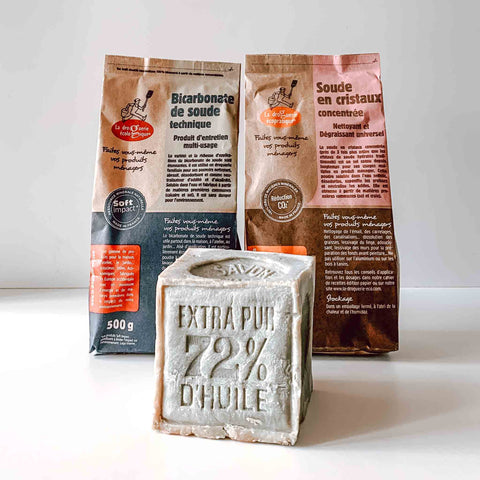

Making your own laundry detergent with Marseille soap is an increasingly popular choice these days: it saves money, reduces waste, and is better for both skin and the environment. However, many recipes circulating online are not suitable for modern washing machines. The results can be disappointing: soap residue, poorly washed laundry, clogged seals, unpleasant odors, or even premature breakdowns.
To ensure that homemade laundry detergent remains truly advantageous, here are the most common mistakes to avoid, and simple solutions to implement.
Choosing a soap not suitable for homemade laundry
The quality of the soap used is the foundation of successful homemade laundry. Many people use soap containing glycerin, or so-called Marseille soap made with palm oil. This type of soap leaves greasy deposits in the washing machine and contributes to clogging the pipes.
Authentic Marseille soap, on the other hand, allows for optimal detergent dissolution . It's easily recognizable: cooked in a cauldron, made in France, based on olive oil, and without controversial additives. This type of soap guarantees effective laundry and a protected washing machine. It's the main ingredient in the My Better Way Homemade Laundry Kit , designed precisely to avoid these problems.
Using too much homemade laundry detergent
The texture and lack of lather can lead people to believe their laundry won't be properly washed. Many people therefore add more. This is the most common mistake. Natural laundry detergent is concentrated: a moderate dose is sufficient. Any more than that, and the soap no longer dissolves properly, sticks to surfaces, and forms a film that promotes unpleasant odors. A dose of 50 to 100 ml per wash is generally more than enough.
Ignoring the limescale present in the water
Soap and limescale don't mix. Together, they produce a deposit called "soap and limescale," which solidifies on the seals and inside the drum. Hard water always requires a natural softener to avoid these problems. White vinegar or citric acid are perfect for this: used in the fabric softener compartment, it prevents the buildup of residue and naturally maintains the machine. If you use citric acid, you must first dilute it in water so that the mixture is completely liquid.
Adding too many ingredients
Many recipes call for thick mixtures with essential oils, thickeners, etc. The resulting detergent becomes too heavy for the machine, too rich in additives, and difficult to rinse. Simplicity is key: a suitable soap, hot water, a little baking soda and washing soda, and nothing more. By respecting this balance, your laundry will stay soft and your machine protected.
Do not shake the laundry detergent before use.
Homemade laundry detergent doesn't contain stabilizers. The mixture won't be homogeneous after being left to stand. This is normal and doesn't mean it's failed. Simply shake it before each use. If it solidifies, you've probably added too much detergent. You can dilute it with hot water to make it more fluid and ensure even distribution of the detergent in your laundry.
Forgetting to maintain the washing machine
Modern washing machines mostly operate at 30 or 40°C to save energy. However, soap dissolves better at higher temperatures. If no maintenance is performed, residue can accumulate. Once a month, a 60 or 90°C cycle with a little vinegar or citric acid in the drum cleans and dissolves deposits. This simple step helps the machine last longer.
Producing too large quantities in advance
Homemade laundry detergent doesn't contain preservatives. If stored for too long, it can ferment, smell bad, or lose its effectiveness. It's best to prepare reasonable quantities to be used within a month.
In summary: homemade laundry detergent is fine, but only with the right ingredients.
Making your own laundry detergent shouldn't be a chore or a risk to your appliances. A few simple steps are all it takes to guarantee impeccable results. And it all starts with choosing the right soap and proportions.
My Better Way offers a sheet of sticky recipes to attach to your laundry detergent bottle so you no longer have to struggle! A simplified and tested recipe that protects your laundry, your skin and your washing machine.