Bottled Water vs. Eco-Friendly Alternatives for Drinking Quality Water in France 🌍💧
In 2021, a shocking statistic came to light: 83% of French people continue to consume bottled water, totaling over 9 billion liters of water per year in France alone. This places France fifth in the world in terms of plastic water bottle consumption. 🇫🇷🌊
The Consequences of Plastic on the Environment 🚯
Yet, we are all aware of the disastrous consequences of plastic on the environment. Most plastic bottles are rarely recycled and often end up in nature or the oceans. Even worse, microplastics break off from these bottles and end up in our stomachs. It is even reported that we ingest the equivalent of a credit card's worth of plastic every week, or about 5 grams! 🚫🌿
Recently, I had the opportunity to travel to the Canary Islands in Spain, where I noticed that the deposit system for glass containers was still in place and working very well, even for individuals. Unfortunately, this sustainable approach is not yet very widespread in France. 🏝️🌿
Drinking Tap Water: An Eco-Friendly Alternative 🚰
However, there are simple, eco-friendly, and economical alternatives to avoid this widespread pollution: drinking tap water. 💧
The Tap Water Taste Challenge 🤢
It's true that the taste and quality of tap water in France aren't always pleasant. While it helps avoid the issue of plastic and waste, the chlorine taste can sometimes be a deal-breaker. 🚰👅
The State of Water in France 🇫🇷
The UFC, a consumer association, points out that nearly 96% of consumers can drink their tap water with confidence, but unfortunately, 2.8 million people have access to polluted water, particularly contaminated by pesticides, nitrates, or lead. 📊🚫
Solutions for Better Water Quality 🌱
So, what are the eco-friendly alternatives for easily purifying your tap water at a lower cost? 💡
"EM" Ceramic Beads 🍶
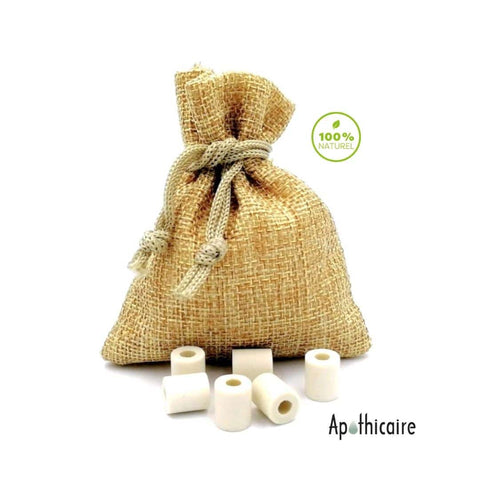
Rather than filtering water using traditional methods, its quality can be improved with a Japanese process. Clay beads are heated to extremely high temperatures, up to 1000°C, to create ceramic beads enriched with beneficial microorganisms, called "EM". 🇯🇵🔬
The Power of Microorganisms 🦠
The action of these microorganisms significantly softens the water, eliminates the unpleasant taste of chlorine, and prevents limescale buildup. Simply add a few pearls to a carafe, about ten per liter of water, for softer, more pleasant-tasting water. 🌊🍶
Pink Pearls vs. Gray Pearls 🌸🪙
There are two types of beads: pink beads, recommended for purifying drinking water, and gray beads, which are more effective against limescale and suitable for household appliances. Pink beads are porous and absorb heavy metals and chemicals from drinking water, but their lifespan is only 6 to 8 months. In contrast, gray beads are extremely durable, with a lifespan of 10 years. 🌸🪙
Binchotan Activated Charcoal 🌿🌑
Another solution for filtering tap water is to use activated charcoal, such as Binchotan, by immersing it in a carafe of water. This activated charcoal is derived from wood combustion, and its patented process allows it to filter tap water by removing chlorine and softening the water's pH. 🍃🌑
A Sustainable Alternative 🔄
Just like ceramic beads, the porosity of activated charcoal allows it to capture chemicals and heavy metals through absorption. Simply leave the charcoal in the carafe for 4 to 8 hours. In addition, this charcoal releases minerals and trace elements beneficial to our bodies. Once it is no longer effective (approximately every 6 months), it can be composted or reused in various ways. 🔄🌿
Solutions to Adopt 🌱
While the effectiveness of these products can sometimes be debated due to a lack of conclusive scientific evidence, many people, myself included, have noticed significant improvements in tap water quality by using these solutions, even in areas with very hard water that tastes unpleasant. This approach also helps reduce the consumption of plastic water bottles. 🙌🌊
Adopting a Reusable Water Bottle 🥤🌿
To further encourage this eco-friendly approach, equip yourself with a glass or stainless steel water bottle that you can fill with filtered water and take with you everywhere. 💧🌍
If you enjoyed this article, feel free to subscribe to my newsletter to receive more tips and discoveries aimed at reducing your daily environmental impact. Together, we can do better for the planet by choosing simple and eco-friendly alternatives. 🌱